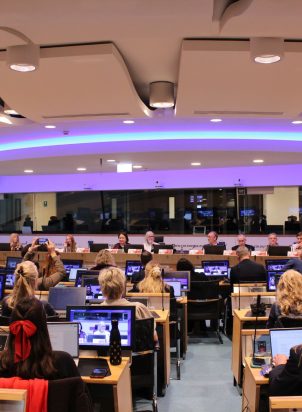
In December, the Arctic Athabaskan Council hosted a workshop in Yellowknife as part of the project Enhancing Northern Connectivity: North-to-North Cooperation for Community Preparedness and Resilience. The project is led by the Arctic Mayors Forum, with Nordregio and Harvard University as partners. Nordregio Senior Research Advisor Ágúst Bogason took part in the workshop, contributing Nordic perspectives and reflections.
The Arctic Athabaskan Council (AAC) is a Permanent Participant to the Arctic Council, representing Indigenous peoples of Athabaskan descent across Alaska (United States), Yukon, and the Northwest Territories (Canada). Today, AAC represents close to 80 communities and approximately 45,000 people, sharing a cultural heritage across a traditional territory of around 3 million square kilometres.

Bogason joined the workshop to help analyse the needs and pressing issues raised by chiefs, elders, and community leaders from the Northwest Territories and beyond. His role was also to provide a Nordic perspective on preparedness governance: identifying urgent challenges in the Nordic Region and exploring how knowledge-sharing between Arctic municipalities and local authorities in the Nordic countries and North America could support more practical action.
“Preparedness depends on trust and relationships as much as on infrastructure. The task ahead is building trust, and exploring whether Nordic principles such as transparency, local decision-making, and strong governance can offer useful lessons,” says Bogason, reflecting on the discussions.
The project Enhancing Northern Connectivity: North-to-North Cooperation for Community Preparedness and Resilience aims to turn research into action by co-creating strategies with communities, identifying concrete steps, clarifying policy and funding levers, and building advocacy pathways. The intention is to ensure that shared knowledge leads to programmes that strengthen community preparedness and resilience. This means engaging directly with the questions communities are asking, exploring where and how answers can be found, and developing solutions with communities, rather than for them.
Bogason’s reflections following the workshop
A cultural encounter
The workshop was, above all, a cultural encounter. Discussions revealed tensions between story and statistics, ceremony and policy, and traditional knowledge and Western science. In First Nation political culture, stories are not decorative. They form the foundation of truth, carrying law, ethics, and environmental knowledge. Asking for a simple “yes” or “no” often misses the point. Knowledge is relational, contextual, and built over time, rather than something that can be reduced to a binary answer.
Nature as indicator
Early in the workshop, one phrase stood out: “The animals are the indicators.” Wildlife behaviour is read as a complex signal system. Whales moving upriver, polar bears heading south, grizzlies moving north – and even interbreeding with polar bears – were cited as signs of environmental change. These observations are not seen as curiosities, but as warnings within a web of interdependence that communities observe closely.
This way of reading change goes beyond animals. Ice conditions, river behaviour, and plant cycles were also discussed as key indicators. These observations are systematic and grounded in generations of experience. Ignoring them not only risks overlooking critical knowledge, but also reinforces mistrust, as traditional observations are rarely given equal weight in official planning processes.
Preparedness as spiritual and moral work
Another aspect of the discussions was how spirituality, prophecy, and ceremonial responsibilities were addressed alongside budgets, policies, and emergency protocols. Preparedness was understood as both technical and moral work, linking communities to land, ancestors, and future generations.
One example discussed was the “feeding of the fire” ceremony, described as part of wildfire response. For many, this is not symbolic but a way of honouring relationships with the land and restoring balance before action is taken, illustrating how spiritual responsibilities and emergency planning are deeply interconnected.
Trust, power, and governance
The workshop showed some scepticism towards Western science, particularly as it relates to federal and territorial authorities. Community members spoke of having to “fight to be heard” and of being asked to prove knowledge they already hold through external data requirements. The resulting power imbalances leave some feeling sidelined.
Many participants emphasised that Western science is necessary alongside traditional knowledge, but that control must remain local. The goal is co-production under Indigenous leadership, not token consultation. At its core, this is about whose knowledge shapes decisions, and whether traditional knowledge is genuinely valued alongside scientific evidence.
The task ahead
Looking through Nordic lenses at the relationship between federal and territorial authorities and Indigenous people, building trust is the central challenge in preparedness efforts. Trust and respectful relationships are more fundamental than infrastructure or formal protocols. Without them, response systems are unlikely to function effectively when they are most needed.
This raises an important question for Nordic actors: can Nordic approaches to preparedness – including transparency, decision-making close to communities, and strong local governance – offer useful lessons in this context?