Nordregio maps the old-age dependency ratio across the Nordic region at the region and municipal level in 2026. The ratio is calculated as the total number of individuals age 65 or older per 100 individuals between 15 and 64 years of age. The higher the number—shown with darker colours—indicate a larger share of older population.
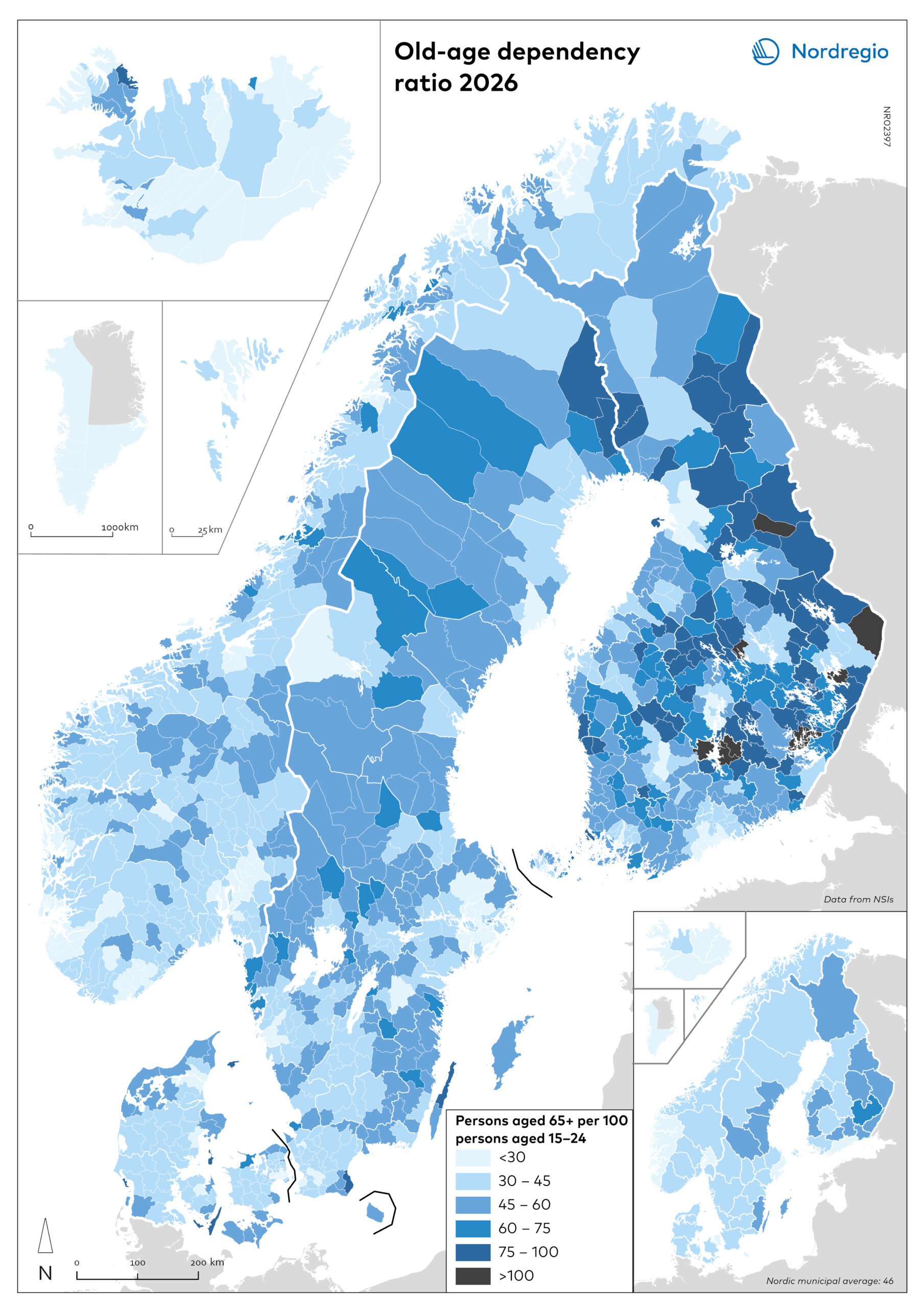
All countries show varied age patterns. Some very high values can be seen in Finland, where eight municipalities have values over 100, which means that there are more people in these municipalities age 65 or older than age 15–64. Another interesting finding in Finland is how we see a lower old-age dependency ratio around Helsinki, and how the value increases as you move further away from the capital. Lower old-age dependency is also found in the other Nordic capitals, along with other larger cities such as Aarhus, Bergen, Gothenburg, and Tampere.
A map with the same theme was made for 2016, and a map with projected values for 2030 was released in State of the Nordic Region 2018 (p. 31). Looking at the 2016 map, different ranges were used to display the data. This makes manual comparison a bit trickier, but one important takeaway is that the Nordic average has increased from 29.7 to 46 in the last 10 years. If same ranges were used on the 2026 data, almost 60% of the municipalities would fall into the >40 category.
