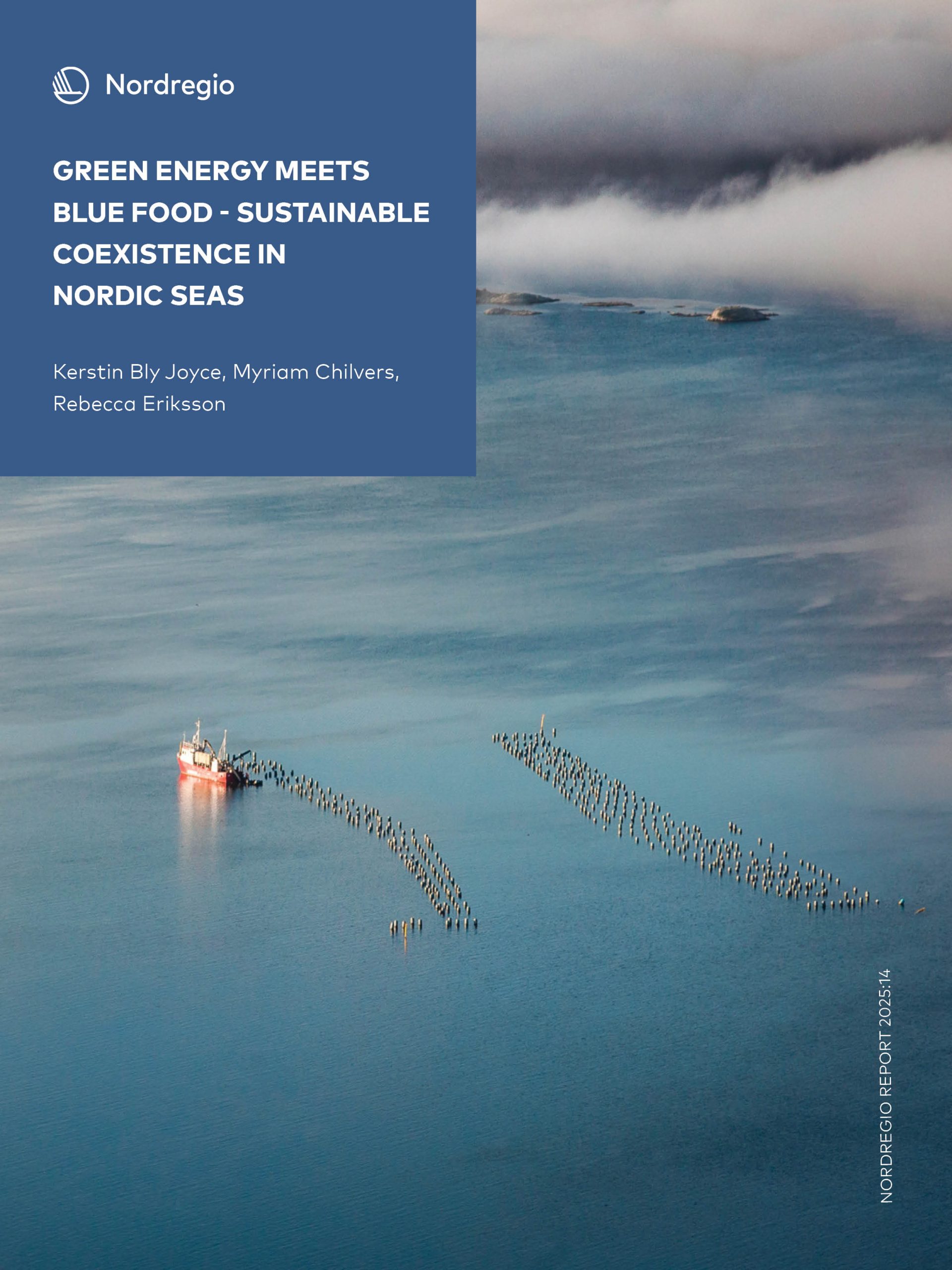
As offshore wind power expands to meet ambitious climate and energy targets, it creates tensions and conflict over space. This report explores how Nordic countries can balance offshore renewable green energy development – particularly offshore wind power – with the continued vitality of blue food production, focusing on fisheries.
This report documents the “Green Energy Meets Blue Food – Sustainable Coexistence in Nordic Seas” project, funded by the Nordic Council of Ministers for Fisheries, Aquaculture, Food and Forestry (EK-FJLS), and summarises the project’s journey and key outputs.
The findings show that coexistence depends not only on technical or spatial planning solutions but also on collaboration between sectors and effective governance. Success requires coherent policies, transparent decision-making, inclusive stakeholder participation and mutual trust between sectors.
Marine and maritime spatial planning (MSP), along with permitting frameworks, are essential tools, but must integrate environmental, economic and social objectives while managing trade-offs and adapting to new environmental and societal pressures.
The expansion of offshore wind energy and the sustainable development of Nordic blue food systems are not inherently conflicting goals. But long-term coexistence requires not only national-level alignment but also cross-Nordic learning and coordination. By fostering shared understanding, trust and adaptive management, the Nordic Region can advance towards a resilient marine economy in which green energy ambitions and blue food security reinforce rather than undermine each other.