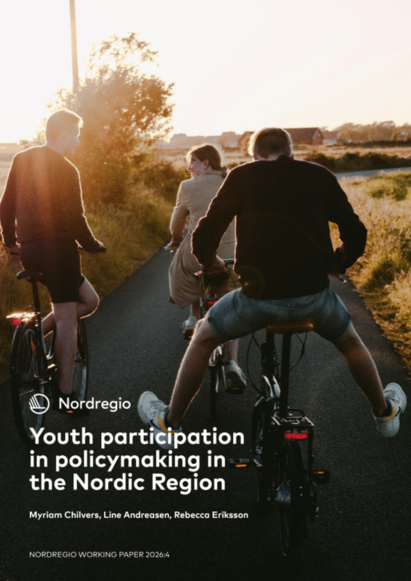
This working paper examines how youth participation in policymaking is organised across the Nordic Region and explores what it takes for participation to become meaningful and impactful, particularly in rural and intermediate areas. It serves as the conceptual foundation for the Nordregio-led project Young and Rooted: Strengthening Youth Representation in Nordic Regions.
Drawing on literature, policy analysis and interviews with national youth councils in Denmark, Finland, Norway and Sweden, the paper analyses youth participation through the lens of democratic resilience. It examines how participation is institutionalised across different
Nordic contexts and why some forms of engagement are more influential than others.
The paper highlights that while the Nordic countries perform strongly on many democratic indicators, youth participation remains uneven in practice. Rural and intermediate regions often face a double challenge: lower levels of political engagement combined with fewer opportunities for young people to influence decisions that affect their communities.
Highlights
The report’s key messages centre around three themes, all aimed at strengthening impactful youth participation in local and regional governance:
Moving beyond participation as a formal requirement
Youth participation should not be measured by the number of consultations, councils or surveys alone. Meaningful participation requires clear pathways between youth input and public decision-making.
Strengthening leadership and institutional support
Effective participation depends on political leadership, dedicated resources and a shared understanding across public institutions of why youth engagement matters and how it should be embedded in governance.
Aligning participation, representation and influence
Using the metaphor of a Rubik’s Cube, the report argues that impactful participation depends on aligning three dimensions: who participates, how participation is organised and the influence young people have. When these dimensions reinforce one another, participation becomes a meaningful part of democratic decision-making rather than a symbolic exercise.
The work is part of the Nordic thematic group for local and regional resilience and attractiveness. The Nordic thematic groups contribute to the Nordic Co-operation Programme for Regional Development and Planning 2025–2030 under the Nordic Council of Ministers’ Committee of Senior Officials for Regional Policy (EK-R).