Abstract
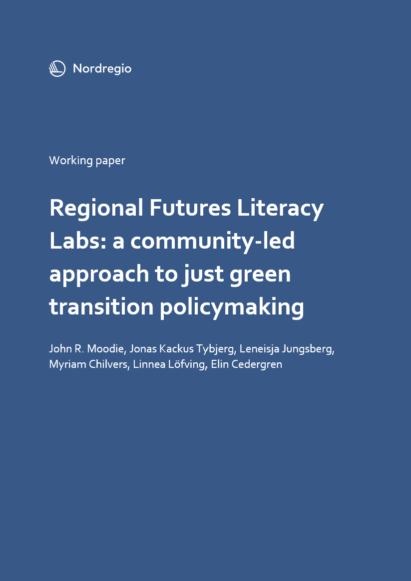
This paper examines the impacts of Regional Futures Literacy Labs (RFLLs) on participants through the conceptual lens of community-led approaches to just green transition (JGT) policymaking. Focusing on RFLLs implemented in the Norrbotten region, Sweden, with members of the rural community, the paper explores whether RFLLs deliver on the key expected impacts of community-led approaches relating to enhanced social capital, learning, empowerment, and resilience. Drawing on questionnaires, semi-structured interviews, and participatory observations, the paper provides a participant perception-based assessment of RFLL short-term impacts.
The findings indicate that RFLLs supported cognitive learning and fostered bonding social capital through dialogue and knowledge exchange. Participants also reported increased confidence to engage in policymaking, reflecting process-oriented aspects of empowerment. However, evidence of strengthened relationships with policymakers and influence on policy processes was limited. RFLLs also encouraged anticipatory thinking and generated new ideas for action, contributing to short-term cognitive dimensions of resilience, but the extent to which these impacts translate into sustained behavioural change or longer-term adaptive capacity remains uncertain.
Overall, the findings highlight both the potential and limitations of community-led processes. Their longer-term relevance for JGT policymaking is likely to depend on their integration into institutional processes and the continuity of community engagement over time.
Keywords
Just green transitions, regional futures literacy labs, community-led policymaking
_______________
This Nordregio Working Paper presents the title and abstract of an article that has been published in European Journal of Spatial Development. The full article is available here: https://journals.polito.it/index.php/EJSD/article/view/539